




On this page
A coloured contact lens doesn't look particularly complicated. It's tiny, soft and, at first glance, seems like little more than a circle of colour. In reality, there's a surprising amount packed into those 14.50 millimetres.
A MesmerEyez lens brings together several very different disciplines: British colour design, iris artwork, polymer science, precision manufacturing, hydration, sterilisation and quality control. The colour has to be carefully designed and material has to perform for the comfort of the wearer. The finished lens has to be formed to precise dimensions and checked before it ever reaches its packaging.
Then we have to consider the eyes themselves. If you look closely at your eyes in the mirror, you’ll notice that your iris isn't one flat shade. Look even closer and you'll see tiny variations in pigmentation, radial fibres (thread-like structures), darker edges and subtle changes around the pupil. Recreating some of that detail on a lens smaller than a fingernail is where the true artistry comes in.
For MesmerEyez, that process starts in Britain. Founded in the UK in 2007, the brand has spent almost two decades specialising in coloured contact lenses. Two technologies sit at the centre of that work: MesmerColour™, the British-developed approach to colour and iris design, and SkinSoft™, the material technology behind the lens itself. One is about how the finished eye looks and the other is about how the lens feels to wear. Both have to work on a canvas measuring just 14.50 mm!
It Starts With the Colour, Not the Lens
A new MesmerEyez colour starts as a design idea, long before there is a finished lens to hold between your fingers. The starting point might be a particular shade of hazel, a cooler grey or a green with a warmer undertone. From there, the design team builds the iris artwork around the details that make an eye look like an eye: changes in tone, fine patterning, opacity and the transition around the pupil and outer edge. It's much closer to designing a tiny piece of artwork than picking a colour from a swatch.
Remember that the colour doesn't exist in isolation. The underlying eye becomes part of it, too and has a huge impact on the overall appearance of the eyes. A design placed over dark brown eyes will interact differently with the natural pigmentation underneath than it will over lighter eyes.
That's why a MesmerEyez shade can have slightly different character from one wearer to another and exude a different vibe.
A 14.50 mm Canvas Is Smaller Than You Think
Take a ruler and look at 14.50 mm. It's tiny. Now imagine fitting an entire iris design inside it, with the colour pattern, optical area and precise lens geometry all landing exactly where they're supposed to. There isn't much room for error.
That’s where a very precise type of manufacturing comes in. The lens has a defined 14.50 mm diameter and 8.60 mm base curve, alongside carefully specified material properties. During formation, the terpolymer hydrogel has to be shaped to those requirements so the finished lens has the intended geometry.
If that doesn’t make any sense to you, think of it like this: it's a little like making something to fit a lock. Being a millimetre out isn't a minor design choice when the finished product is sitting directly on the eye. This is one of those details that's easy to take for granted when looking at a finished lens. You see the colour first. The measurements are invisible. That doesn’t mean they’re not extremely important.
The Colour Isn't Simply Painted Onto the Lens
Most people assume this is how the magic happens and it sounds logical, doesn't it? Take a clear contact lens, add some colour to it, and you're done.
The reality is more complicated and quite an intricate process. The colour used to create the MesmerColour™ iris artwork is encapsulated within the lens structure rather than simply sitting as an exposed layer on the surface. So the colour is part of the construction of the lens itself, alongside everything else that has to be precisely formed.
Amazingly, within that tiny space the manufacturing process has to accommodate the iris artwork, different colour elements and the central optical area. The position of those elements matters if the lens is to have the intended effect. If you imagine printing a detailed image on a tiny piece of paper. Now make that paper curved, flexible and designed to sit on the eye. Suddenly, getting every detail in the right place becomes a rather different challenge.
The colour artwork also has to translate from the original British design into the finished lens with the intended tones, patterns and transitions. It isn't simply a case of making something colourful and hoping for the best. MesmerColour™ determines the visual design and precision manufacturing determines how accurately that design makes it onto the finished lens.
Quite a lot of work for something smaller than your fingernail when you think about it.
What Makes a Contact Lens Comfortable?
A lens can look fantastic and still be a complete non-starter if you don't want to keep it in your eye. For MesmerEyez, comfort starts with the material itself. SkinSoft™ uses a specially developed terpolymer hydrogel, designed to balance several things at once rather than relying on one property to do all the work.
42% water content
Water makes up approximately 42% of the hydrated material in the standard specification. The terpolymer is designed to retain that water within its structure while the lens is being worn (so it won’t suddenly dry out!)
Approximately Dk 26 oxygen permeability
Oxygen needs to reach the cornea, and the hydrated hydrogel allows oxygen to travel through the material towards the eye.
Three-part polymer structure
A terpolymer incorporates three different monomer components into its polymer structure. That gives the material the ability to balance water retention, dimensional stability, biocompatibility and oxygen permeability.
Soft, but not flimsy
This bit matters. A lens needs to be soft and flexible, but it also needs enough stability to maintain its intended shape and geometry.
From British Design to a Finished Lens
So, you might be wondering what actually happens between a colour being designed in Britain and a finished lens arriving at your door in the UAE? Here’s everything you need to know:
1. The design comes first
The intended colour, iris artwork, opacity, transitions and overall character of the lens are established during the British design stage.
2. The lens is engineered
The material and physical specifications are set, including the 14.50 mm diameter and 8.60 mm base curve. At this point, we're no longer talking about artwork. We're talking about making the lens itself.
3. The lens takes shape
The terpolymer hydrogel is formed using specialist contact-lens manufacturing processes to create the required geometry. This is where those tiny measurements become very real.
4. The colour becomes part of the lens
The MesmerColour™ iris artwork is reproduced during the manufacturing process, with the pigments encapsulated within the lens structure.
5. Then comes hydration
The hydrogel absorbs water and reaches its final soft, flexible state. In the standard specification, water accounts for approximately 42% of the hydrated material.
6. Then comes the checking
Physical dimensions, geometry, optical characteristics, colour consistency, iris positioning, surface and edge quality, packaging and other manufacturing characteristics can all be examined as part of quality control.
7. Finally, sterilisation and packaging
The finished lenses are hydrated in the appropriate solution, sealed individually in sterile packaging and sterilised through a validated process. Batch and expiry information are retained for traceability.
8. You receive your coloured contact lenses!
After all that hard work to create the perfect product, you can now wear your new coloured contact lenses.
Nearly 20 Years of Making Coloured Contact Lenses
MesmerEyez began in Britain in 2007, long before coloured contact lenses became quite as easy to find as they are today. That growth has been great for choice, but it has also made it more important to know where your lenses are coming from. In Dubai, coloured lenses can turn up through all sorts of sellers, including social media accounts and informal beauty businesses. A nice-looking Instagram page isn't the same thing as knowing what you're actually buying.
For something that sits directly on your eye, that's a distinction worth making. MesmerEyez has been designing coloured contact lenses in Britain for almost two decades, with applicable products manufactured and supplied to meet relevant UK and European regulatory requirements, including applicable UKCA and CE requirements.
A beautiful colour isn't much use if the lens doesn't feel right. And a technically well-made lens still needs a colour people actually want to wear.
So if you're buying coloured contact lenses in the UAE, don't choose based on a pretty product photo alone. Look at who made them, where they're manufactured, what regulatory requirements they meet and whether the seller can actually tell you what you're buying.
Why British Design Matters to MesmerEyez
British design isn't just about where the company started. It's part of how MesmerEyez approaches colour. The aim isn't to follow every new beauty trend or make the most dramatic lens possible. Some colours are deliberately quiet and understated. Others are designed to make more of an impression. Either way, there is a lot of thought behind something that takes up less space than a fingernail.That balance between creativity and precision runs through the whole process. The design team is thinking about colour, pattern and detail, while the manufacturing side is dealing with material performance, measurements and consistency. Different jobs, but they have to meet in the same 14.50 mm space. The finished lens may look simple but getting there certainly isn't.
Frequently Asked Questions
How are coloured contact lenses made?
Coloured contact lenses combine several stages, including colour and iris design, lens formation, colour application, hydration, quality control, sterilisation and packaging. For MesmerEyez, the colour is designed in Britain using MesmerColour™ technology, while the lens itself uses a terpolymer hydrogel developed around the SkinSoft™ approach.
How is the colour put into a contact lens?
MesmerEyez uses encapsulated colour technology. The pigments used for the MesmerColour™ iris artwork are incorporated within the lens structure rather than simply painted onto the surface. The artwork has to be reproduced precisely within a lens measuring just 14.50 mm across.
What are MesmerEyez coloured contact lenses made from?
MesmerEyez lenses use a specially developed terpolymer hydrogel. The standard specification contains approximately 42% water and has oxygen permeability of approximately Dk 26. The material is designed to balance hydration, flexibility, dimensional stability, biocompatibility and oxygen permeability.
Where are MesmerEyez coloured contact lenses designed?
MesmerEyez colours are designed in Britain, where the iris artwork and colour designs are developed. The finished lenses are produced through specialist contact-lens manufacturing processes and supplied to meet applicable UK and European regulatory requirements, including relevant UKCA and CE requirements.

Find your colour
Find your perfect lens colour
Shop the UAE's most-loved coloured contacts — CE-certified, breathable and made to suit darker eyes.
The MesmerEyez Journal
Keep reading

Can Coloured Lenses Make Your Eyes Look Bigger?
Big, bright, expressive eyes have been considered beautiful across countless beauty trends. The details cha...
Sep 8, 2026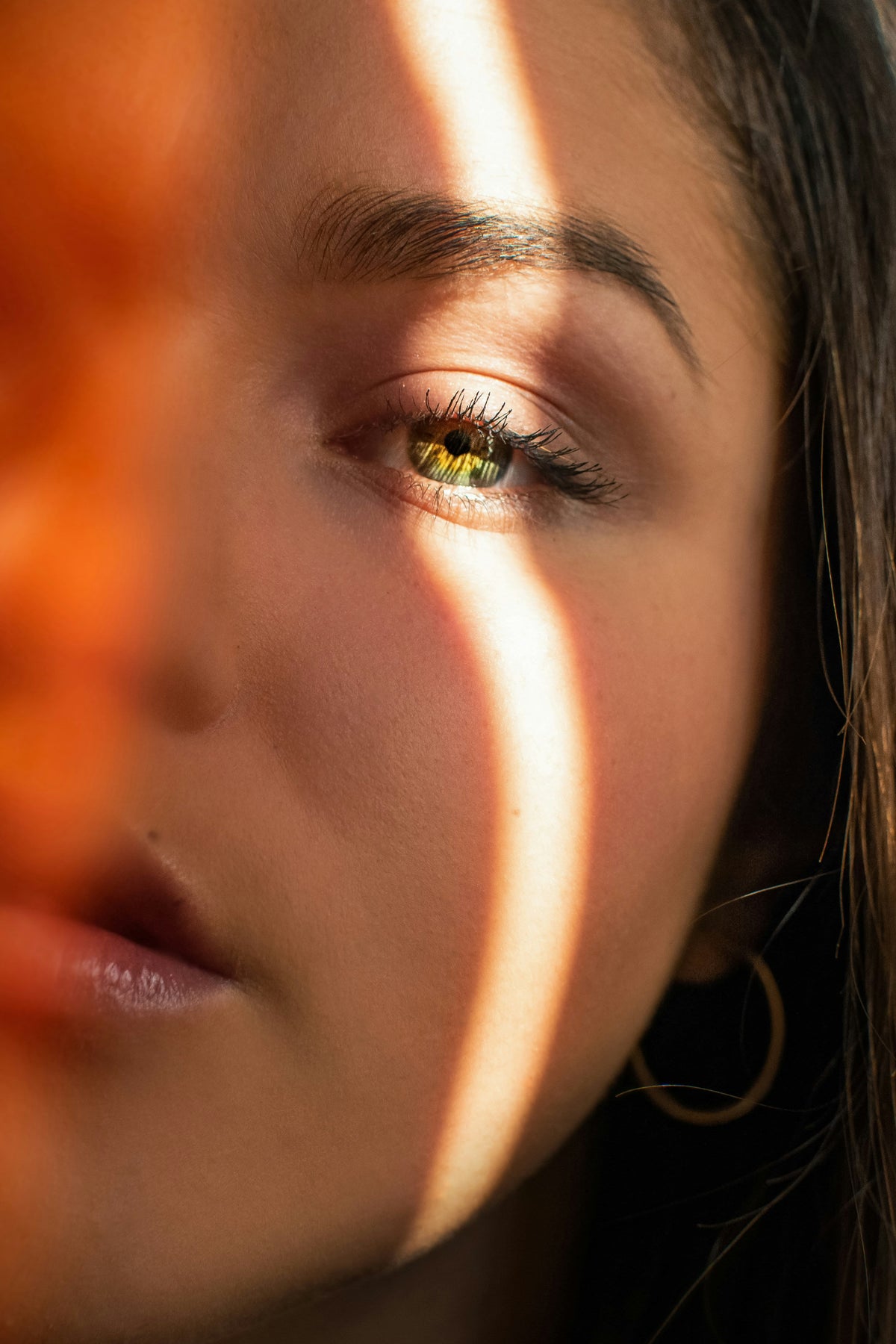
The UAE Beauty Switch-Up: How to Refresh Your Look When Summer Ends
In the UAE, September doesn't exactly arrive with a crisp breeze and an invitation to dig out your favourit...
Sep 4, 2026
Inside Out: How to Tell If You've Put Your Contact Lens in the Wrong Way
We've all had those mornings where you're already dressed, makeup is halfway done, you've got somewhere to ...
Aug 25, 2026